The 30-Person Problem
Too many for a dinner party. Too few for a venue. How to plan the gathering that falls in the awkward middle — and make it feel intentional.

The 30-Person Problem
There's a gathering size that doesn't have a format. Twelve people is a dinner party — you know what that looks like. Sixty people is a party — rent a space, hire a caterer, set up a playlist. Both of these have clear playbooks.
Thirty people has neither.
Thirty is too many for a seated dinner unless you have a dining room designed for it. It's too few for a venue — the space feels empty, the cost per head is hard to justify, and the energy dissipates. It's the precise size where the instinct to host at home is correct but the logistics of doing so become genuinely complicated.
Most hosts discover this the hard way. They plan for 30 the way they plan for 15 — same approach, double the quantities — and the evening buckles under the weight of problems that didn't exist at half the size. The food takes twice as long to serve. The seating doesn't work. The conversation fragments into isolated clusters that never reconnect.
The 30-person gathering isn't a scaled-up dinner party or a scaled-down event. It's its own format, and it requires its own approach.
The space problem
The first constraint is physical. Most living rooms and dining rooms are designed for the people who live there, plus a reasonable number of guests. Twelve to sixteen is usually the comfortable limit. Beyond that, the room starts working against the gathering rather than for it.
At 30, the host needs to think about the space differently — not as a single room with a table, but as a set of zones that serve different purposes.
A food station in the kitchen or near it, where guests serve themselves. A main gathering area where most of the conversation happens, with enough seating for roughly half the guests (not everyone sits at the same time). A secondary area — a patio, a den, a hallway with seating — where smaller conversations can happen away from the main energy.
This zone approach solves two problems simultaneously. It distributes the crowd so no single room feels overcrowded, and it creates natural movement — guests circulate between zones rather than anchoring in one spot, which keeps the energy alive and the conversations varied.
The mistake to avoid: pushing all the furniture against the walls to "create space." This looks like a school dance. Leave some furniture where it is. People need surfaces, backs to lean against, and defined areas to inhabit. An open floor with nowhere to land is less comfortable, not more.
The food format
At 30, seated dinner service becomes impractical unless you have the infrastructure — a table (or tables) that seat everyone, enough identical place settings, and the ability to serve a plated meal to 30 people while it's still warm. Most home hosts don't have this, and there's no reason to pretend otherwise.
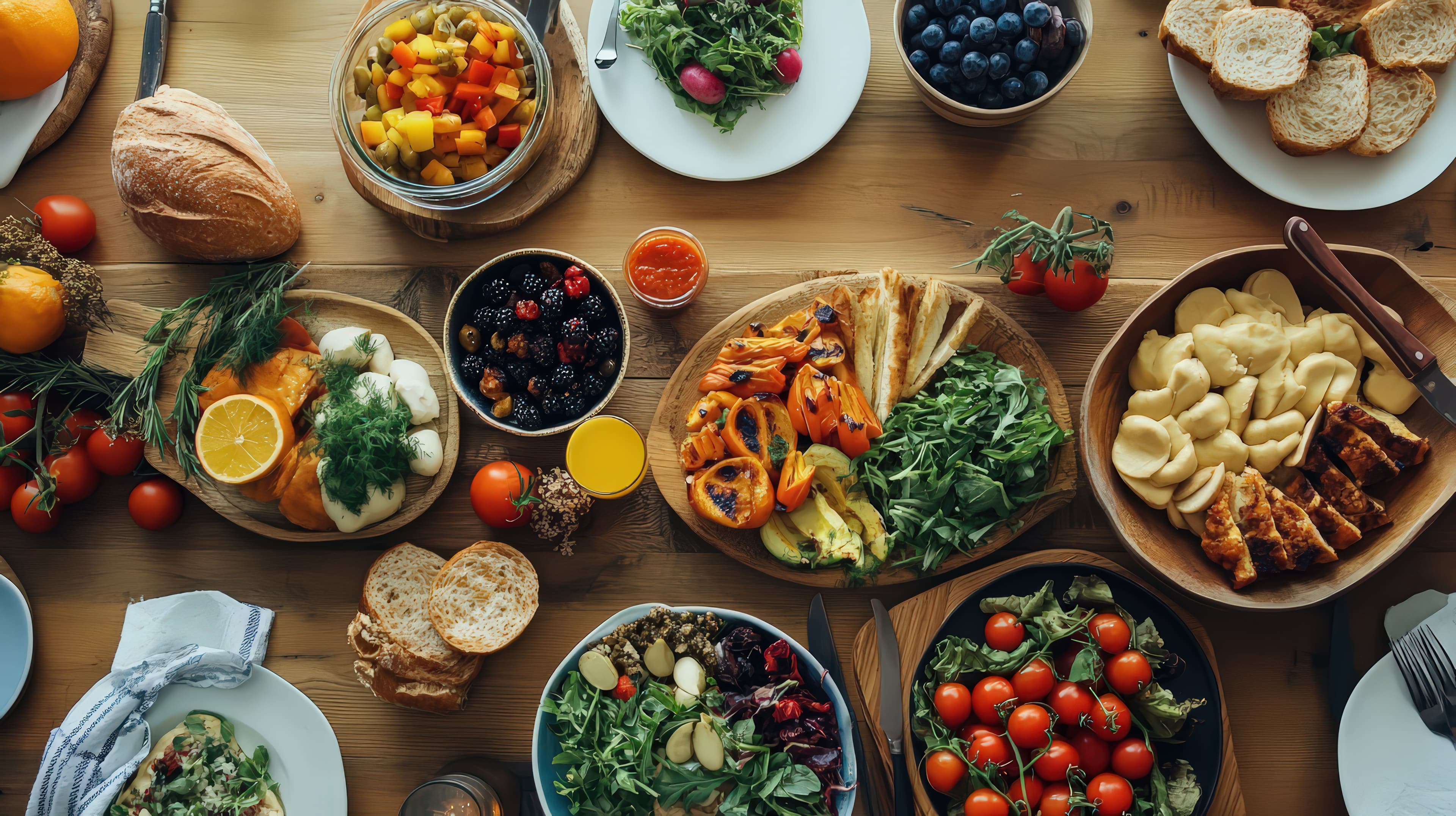
The format that works: a generous buffet with a clear layout, designed for self-service flow.
Build the spread for grazing rather than a single seating. This means dishes that hold well at room temperature, a replenishment plan (a second batch of the main dish warming in the kitchen, fresh platters of appetizers staged and ready), and enough serving space that guests aren't queuing in a single file.
The quantity calculation changes at 30. The standard formula — one portion per guest per dish — works for a seated dinner where everyone takes one serving. At a buffet, guests take smaller amounts of more dishes and often return for seconds. Plan for roughly 1.3 portions per guest on the main dishes, and overshoot on appetizers and sides by 20 percent.
Dessert should be self-serve and available throughout the evening, not presented as a formal course. A table with sweets, fruit, and something substantial lets guests graze on their own schedule rather than waiting for a single serving moment.
The energy arc
A dinner party has a natural arc: arrive, sit, eat, talk, leave. A large party has its own arc: arrive, mingle, peak energy around the midpoint, gradual departures. The 30-person gathering sits between these, and without intentional structure, the energy often plateaus early and then slowly deflates.
The solution is to build two or three natural inflection points into the evening — moments that shift the energy and give the gathering a sense of progression.
The arrival period is the first 30 to 45 minutes. Guests are arriving in waves, the room is still filling, conversations are small and introductory. This is when appetizers and a welcome setup matter most — give people something to do with their hands and a reason to cluster near the food station, which becomes the natural gathering point.
The middle section — roughly the hour to ninety minutes after most guests have arrived — is when the food should be ready and the room should be at its fullest. If you're going to make a brief toast or welcome, this is the moment. It gives the evening a center of gravity.
The late section — the final hour — is when the gathering naturally thins. Some guests leave, the remaining group tightens, and the conversations deepen. Dessert and something warm to drink on the counter signals that the evening is winding down without the host needing to announce it.
The mistake to avoid: trying to keep the entire group together for the entire evening. At 30, the group will naturally split and recombine. This is healthy. The host's job is not to manage the room — it's to give it enough structure that it manages itself.
The seating question
Do not attempt a single seated dinner for 30 unless you have the table for it. This sounds obvious, but the impulse to create a shared meal experience is strong, and hosts regularly underestimate how much infrastructure a 30-person seated dinner requires.
Instead, create a mix. Enough chairs, stools, and surfaces for roughly 20 — some around a table, some in living room seating, some on the patio. The remaining guests will be standing, which is fine as long as they have surfaces to set a plate on and spaces to lean against.
If seated eating is important to you, consider two or three smaller tables rather than one long one. A table of eight and two tables of six are more manageable, more conversational, and more flexible than a single table of 22 with card tables extending into the hallway.
The buffet-and-perch model — guests serve themselves, find a spot to sit or stand, eat when they're ready — is the most forgiving format for this size. It eliminates the coordination challenge of getting 30 people to sit and eat simultaneously, and it lets the evening flow at a natural pace.
The invitation question
The 30-person gathering has a specific invitation challenge: it's too large for a casual text but too personal for a formal announcement. The invitation needs to set expectations about the format — guests should arrive knowing whether this is a dinner, an open house, or something in between.
The wording should communicate three things clearly: the time window (a set period like 5–9 PM signals a structured evening; "from 5 PM onwards" signals a more open format), the food plan (dinner, appetizers, or a buffet — so guests know whether to eat beforehand), and whether families or plus-ones are included (at 30, every additional guest materially changes the dynamics).
A single link with a designed invitation, the details, and a built-in RSVP is especially valuable at this size, because the headcount matters more than it does at 12 (where you can absorb variance) or at 60 (where the caterer handles it). At 30, the difference between 24 and 36 guests is the difference between a comfortable evening and a stressful one.
The 30-person checklist
A week out, the host should have clear answers to five questions.
Space. Where will people eat, stand, and sit? Are there at least two zones? Is the path from the food to the seating areas clear?
Food. Is the spread designed for self-service? Is there a replenishment plan? Are quantities calibrated for buffet-style grazing, not plated portions?
Timing. What's the arrival window? Is there a midpoint moment (a toast, the food reveal) that gives the evening structure? What signals the wind-down?
Seating. Is there enough seating for roughly two-thirds of the guests? Are there surfaces for plates and glasses throughout the space?
Headcount. Is the confirmed number within range of the plan? Is there enough buffer in the food and seating to absorb a few unexpected guests?
The headcount, handled
At 30, the difference between a confirmed headcount and a guess is the difference between a relaxed host and a frantic one. Cordiale gives every event a dashboard with live response tracking — confirmed, maybe, declined, and pending — so the host walks into the evening with a real number, not an estimate.
Free. Two minutes to set up. Create yours →
More hosting guides: The Art of the Guest List · How to Plan Food for a Crowd with Mixed Dietary Needs · How to Plan a Housewarming That People Actually Want to Come To.
Ready to create your invitation?
Pick a vibe and the whole invitation designs itself. Free, no account, no app — for you or your guests.